
1.Model Breakdown
- Type code “6”: Represents deep groove ball bearings, the most versatile bearing type in the industrial field.
- Dimension series code “00”: Model 608 is a thin and light series of deep groove ball bearings, featuring extreme lightweight design and suitable for small-space, light-load scenarios.
- Bore diameter code “8”: Bore diameter calculation rule = code × 5, i.e., 8×5 = 40mm.
This guide delivers a full parameter analysis and application guide for the Deep Groove Ball Bearing 608, a classic thin-light series bearing widely used in industrial mechanical systems.
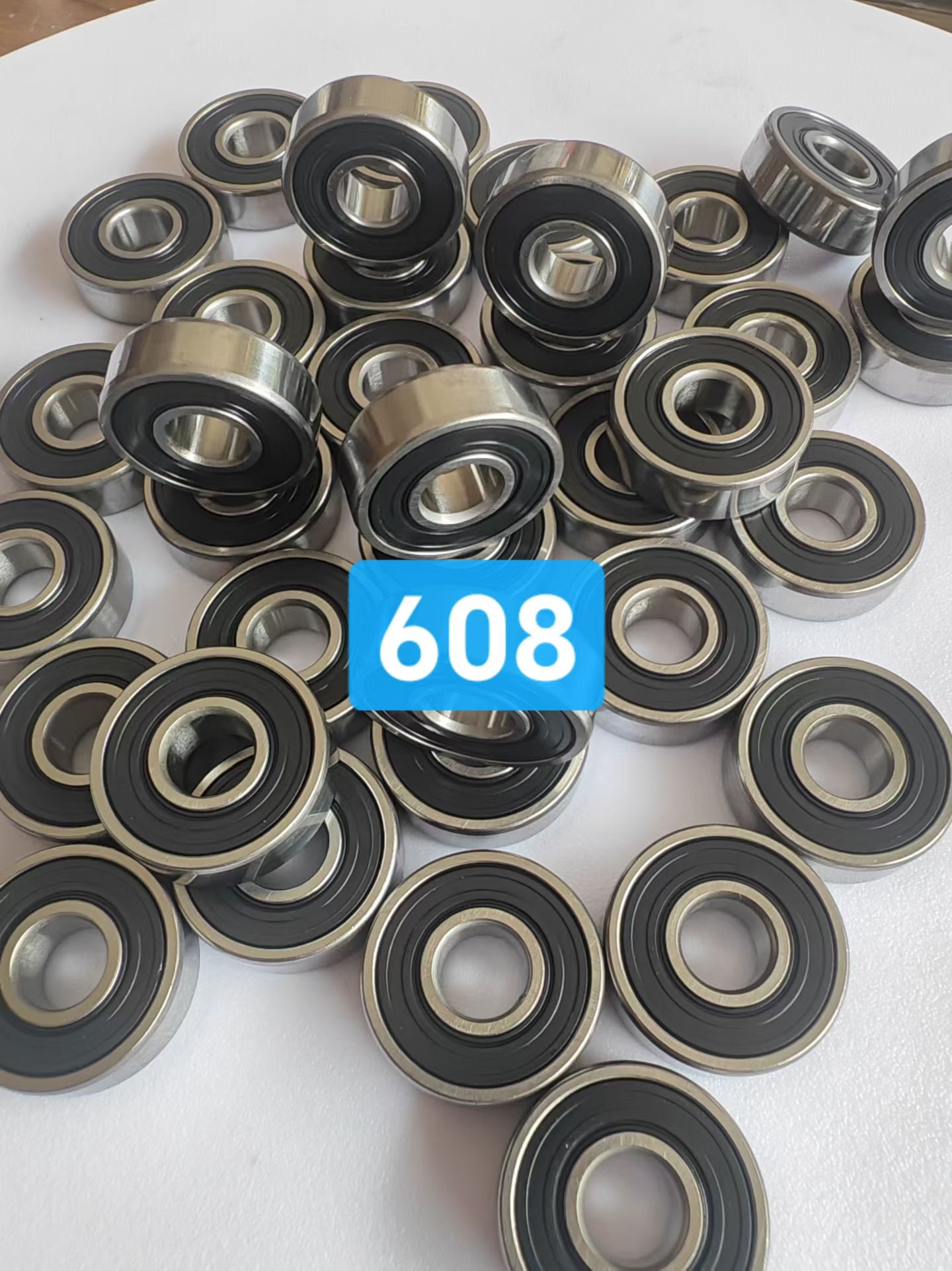
2.Core Key Parameters
- Outer diameter: 90mm
- Width: 23mm
- Basic dynamic load rating C: 35.0kN
- Limiting speed for grease lubrication: 6000r/min
- Limiting speed for oil lubrication: 7500r/min
3.Core Application Scenarios
Suitable for medium-light load, medium-high speed, low noise general mechanical scenarios. With its compact structure and stable performance, it has become a commonly used type in the industrial and equipment manufacturing fields, mainly applicable to:
- General machinery: Rotors of medium-sized motors, fan impellers, water pump shafting, stably transmitting radial power and withstanding slight axial force.
- Engineering machinery: Small reducers, rollers of conveying equipment, auxiliary mechanisms of engineering machinery, adapting to the high-frequency operation requirements of equipment.
- Transmission equipment: Machine tool accessories, spindles of textile machinery, transmission components of printing machines, ensuring low-noise and high-precision operation.
- Transport accessories: Hubs of electric vehicles, transmission systems of motorcycles, adapting to stable support under complex outdoor working conditions.
4.Basic Bearing Knowledge: Core Principle of Rolling Friction
A bearing consists of four core components: inner ring, outer ring, rolling elements, and cage. Its core function is to convert the sliding friction between the shaft and the machine body into rolling friction, reducing the friction coefficient from 0.1~0.3 (sliding friction) to 0.001~0.005 significantly. This notably improves the mechanical operation efficiency, reduces component wear, and extends the overall service life of the equipment.
Suggestion: Draw an exploded view of the Deep Groove Ball Bearing 608 bearing structure, clearly mark the four components (inner ring, outer ring, rolling elements, cage), and use arrows to indicate the running track of rolling elements, intuitively showing the conversion process from sliding friction to rolling friction.
The Deep Groove Ball Bearing 608 is ideal for medium-light load, medium-high speed, low-noise scenarios, making it a top choice for motors, fans, reducers, and EV hubs.
5. Frequently Asked Questions (FAQ)
Q1: What does the suffix “C3” in the bearing model stand for?
A: C3 is the radial internal clearance code, indicating that the radial internal clearance of the bearing is larger than that of the normal group (CN). It is suitable for working conditions with high operating temperature and large thermal expansion difference between the shaft and the bearing, which can effectively avoid bearing seizure caused by excessively small internal clearance at high temperatures. The 608 bearing with C3 suffix is commonly used in medium-sized motors, reducers, high-temperature fans and other equipment.
Q2: Why should direct striking be avoided when installing the 608 bearing?
A: Direct striking with tools such as hammers will cause deformation of the bearing raceway, damage to the rolling elements, and cracking of the cage, directly damaging the bearing clearance and machining accuracy. There will be no obvious faults initially, but the fatigue life of the bearing will be greatly shortened (up to 80% reduction).
Correct Operation: Use a copper sleeve + hydraulic press. Apply uniform pressure to the inner ring for shaft interference fit, and to the outer ring for bearing housing clearance fit to ensure even force and avoid violent operation.
Q3: How to judge whether the lubrication of the Deep Groove Ball Bearing 608 is normal?
A: The grease filling amount is appropriate at 1/3~1/2 of the bearing’s internal cavity: Excessive grease will lead to poor heat dissipation and sudden temperature rise during operation, while insufficient grease will cause dry friction and accelerate component wear.
608 Grease Selection Principles:
- Medium-high speed scenarios (close to the rated speed): Select low-viscosity lithium-based grease (NLGI Grade 1).
- Low-speed and medium-load scenarios: Select medium-high viscosity composite lithium-based grease (NLGI Grade 2~3).
- High-temperature working conditions (>120℃): Select polyurea-based grease or high-temperature lithium-based grease to avoid grease failure.
6. Standard Installation
6.1Standard Installation Steps
- Tool Preparation: Copper sleeve (matching the inner/outer ring size of Deep Groove Ball Bearing 608 ), hydraulic press, feeler gauge, industrial cleaning cloth, grease suitable for the model, gloves.
- Cleaning Treatment: Wipe the journal, bearing housing and surface of the 608 bearing with industrial cleaning agent to completely remove oil stains, iron filings and other impurities; wear gloves throughout the process to avoid contamination of the bearing raceway by hand sweat.
- Lubrication Preparation: Evenly apply a thin layer of grease to the inner wall of the bearing inner ring and the gaps between the rolling elements and the cage to ensure that the key friction parts are covered with lubrication.
- Press-Fitting Operation: Sleeving the bearing on the shaft end smoothly, make the copper sleeve closely against the end face of the bearing inner ring, start the hydraulic press to apply pressure slowly and evenly until the bearing is completely attached to the shaft shoulder without offset or gap.
- Accuracy Inspection: Check the bearing radial internal clearance with a feeler gauge; the suitable clearance range for the 608 bearing is 0.08~0.20mm. Conduct a no-load test run after completion; the installation is successful if there is no abnormal noise and no local heating (temperature rise <20℃) during operation.
6.2 Safe Disassembly Key Points
- Prioritize the use of a hydraulic puller or a special disassembly tool for 608; the puller claws must firmly hook the inner ring of the bearing and pull it out with even force. Avoid hooking the outer ring to prevent damage to the bearing housing.
- It is strictly forbidden to strike the bearing directly with chisels or hammers to prevent journal deformation and scratch on the inner wall of the bearing housing, which will affect the accuracy of subsequent reassembly.
- Check the bearing status immediately after disassembly: If there are problems such as raceway scratches, pitting of rolling elements, blackening of inner and outer rings (high-temperature ablation), and cage deformation, the bearing must be replaced in a timely manner and is prohibited from further use.
7.Deep Groove Ball Bearing 608 Summary
- As a classic model of deep groove ball bearings, the 608 is a universal support choice for mechanical transmission systems with its 40mm bore diameter + thin and light structure, adapting to medium-light load and medium-high speed general scenarios.
- Mastering the model interpretation rules (6-type + 00-dimension series + 8-bore diameter) can quickly match the bearing requirements of equipment, and select whether to add suffixes such as C3 according to the working conditions.
- Standard installation + reasonable lubrication is the key to extending the service life of the Deep Groove Ball Bearing 608 : Avoiding violent striking, controlling the grease filling amount, and selecting grease according to working conditions can increase the service life of the bearing by more than 50%.
- The bearing status must be checked in a timely manner after disassembly; if damage such as scratches and pitting is found, replace it immediately to prevent the fault from spreading and causing damage to other components of the equipment.
Mastering the specifications, installation, and maintenance of the Deep Groove Ball Bearing 608 is key to ensuring stable, long-lasting performance for your mechanical equipment.
Reference: GB/T 272-2017 Rolling bearings – Identification code